
What Interior Designers on North Vancouver Island Need to Understand About AI Right Now
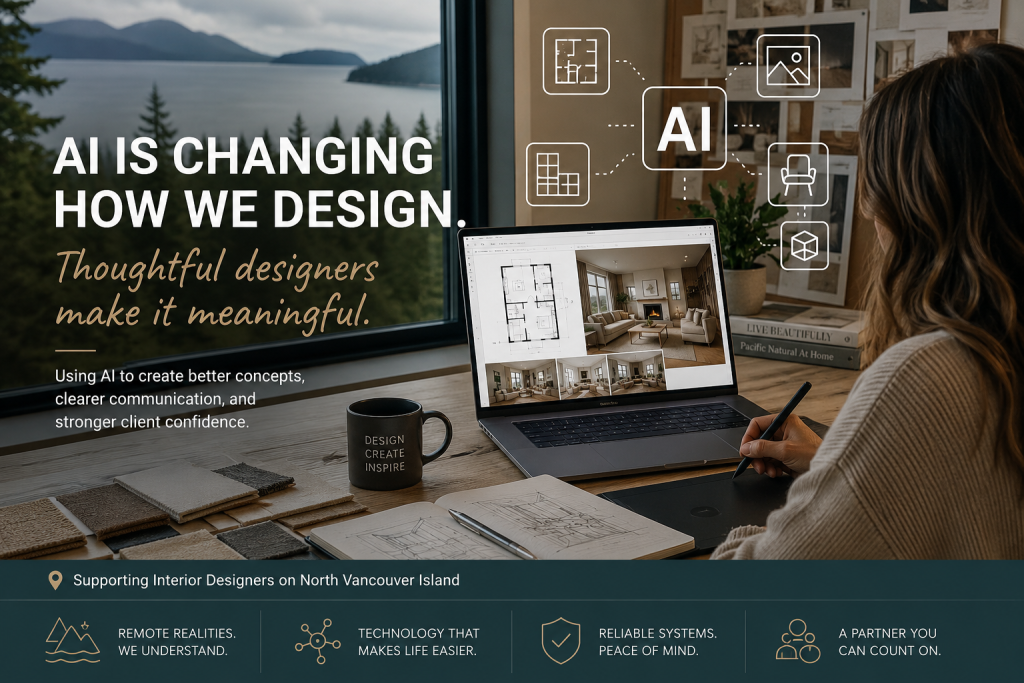
Yesterday, Chief Architect’s “Using AI to Design Homes” webinar focused on something a lot of designers are quietly wrestling with right now:
Not whether AI exists.
But whether it’s going to change the way clients expect design work to happen.
And if I’m being straight with you… it already is.
Not because AI can replace thoughtful interior design.
It can’t.
But because it’s changing how quickly ideas move, how clients visualize spaces, and how much pressure designers feel to produce more concepts in less time.
That matters even more here on North Vancouver Island, where many designers are already balancing limited time, remote coordination, supplier delays, unreliable connectivity, and clients who want fast answers without understanding the complexity behind the work.
This is the part most people don’t say out loud:
A lot of interior designers aren’t worried about AI replacing them.
They’re worried about becoming buried under even more expectations.
And that’s a very different conversation.
AI Is Changing the Front End of Design
One of the biggest themes in the webinar was how AI tools are being used for:
- floor plan generation
- room staging
- rendering enhancement
- concept visualization
- rapid ideation
- client presentation support (Chief Architect)
That sounds exciting on paper.
But what I’ve noticed with designers in smaller and remote communities is that excitement usually comes second.
The first reaction is often:
“Okay… but how much extra work is this actually going to create?”
Because once clients realize AI can generate inspiration images in seconds, expectations shift.
Suddenly clients arrive with:
- Pinterest boards generated by AI
- unrealistic concept images
- rooms that ignore budgets or construction realities
- ideas that “look easy” but aren’t buildable
And now the designer has to become:
- translator
- reality filter
- technical advisor
- project stabilizer
All while still trying to do the actual design work.
The Real Opportunity Isn’t Automation
The webinar touched on how AI can speed up repetitive tasks and help visualize ideas faster. (Chief Architect)
That part is true.
But I think the real opportunity for interior designers is something deeper:
AI removes friction around communication.
That matters because clients often struggle to explain what they want.
You’ve probably seen this already:
- “I want it warm… but modern.”
- “Minimal… but cozy.”
- “High-end… but not expensive.”
AI-generated visual concepts can help clients react emotionally earlier in the process.
Not because the AI “designed the room.”
But because it helped uncover preferences faster.
That can shorten revisions, reduce uncertainty, and make conversations clearer before expensive decisions happen.
Used properly, AI becomes less about replacing creativity and more about reducing ambiguity.
And honestly, reducing ambiguity is one of the most valuable things you can do for a client.
Why This Matters More in Remote Communities
Design businesses on the North Island operate differently than firms in Vancouver or Toronto.
Everything takes longer here.
- Materials take longer.
- Trades coordination is harder.
- Site visits can require ferries or long drives.
- Internet reliability still matters more than people in urban centres realize.
- Clients often expect flexibility because “everyone wears multiple hats.”
So when technology creates more complexity instead of less, it becomes a burden fast.
That’s why I don’t think the winning designers will be the ones using the most AI tools.
I think the winning designers will be the ones who use AI quietly and strategically to create:
- faster clarity
- smoother communication
- fewer revisions
- more client confidence
- less operational chaos
In other words:
technology that reduces stress instead of adding to it.
Clients Still Need Human Judgment
This was the underlying reality beneath the entire webinar.
AI can generate options.
But it doesn’t understand:
- how people actually live
- traffic flow in a home
- emotional comfort
- material longevity
- budget tradeoffs
- contractor realities
- North Island environmental conditions
- what happens when a product is unavailable for 14 weeks
And it definitely doesn’t understand people.
Interior design has never just been about producing visuals.
It’s about helping clients make decisions they feel confident living with later.
That still requires experience.
It still requires discernment.
It still requires trust.
And trust is becoming more valuable — not less.
The Designers Who Will Benefit Most From AI
From what I’ve seen, the designers who will benefit most aren’t the ones chasing every new tool.
They’re the ones asking:
- “Will this save time without lowering quality?”
- “Will this reduce confusion for my clients?”
- “Will this make projects run smoother?”
- “Will this help me protect my energy and focus?”
Because the hidden risk right now isn’t falling behind technologically.
It’s exhausting yourself trying to keep up with everything.
And honestly, most interior designers I talk to don’t need more complexity.
They need systems that help the business feel manageable again.
Final Thought
AI is not the future of interior design.
Human-centered design supported by intelligent tools probably is.
And there’s an important difference between those two things.
The firms that thrive over the next few years likely won’t be the loudest about AI.
They’ll be the ones who quietly use it to:
- communicate better
- reduce friction
- create confidence
- and give clients a calmer, more certain experience from start to finish
Because at the end of the day, clients are not looking for artificial intelligence.
They’re looking for reassurance that someone capable is guiding the process well.
And that part is still deeply human.